

Monty’s Missive #9/2026: 250 and none the wiser?
The one about a round birthday of a nation, the Boll Effect and more...

July 4, 2026

— Distributing the cake.
As the US heads into their 250th “Birthday” since the founding of their grand nation, the globe faces a time of high uncertainty. Trump at the helm, celebrating the glory. Distributing the cake. All while the stock market rages from one all-time-high to the next. It began somewhere around the re-election of Trump, which was probably more symptomatic of the “end of the empire” than the reason for all this. How will it end? Since I am not Nostradamus I can’t see the future even on my best days, but I’d wager it won’t be pretty.
For now, we can celebrate the U.S. of A. having made it to a quarter of a century, while centuries-old Europe struggles to find its identity in a swirl of the 250-year-old looking for ways to untangle from globalization. The underdiscussed energy reshuffling has stepped back to a falling oil price and a “glut” narrative after the shut-ins deliver their crude. Crude or products coming out of the (newly reopened) Strait of Hormuz might be “back on the menu”, but now under full Iranian (IRGC) control – no “tolls” allegedly. My bet would go towards a “fee” of sorts for keeping the lanes clean and nice and maybe tanker captains can get a nice “New Oil Smell” air freshener to hang on their bridge when they pay at the booth?
What it all means is that energy is getting scarcer in places where it already wasn’t much of to begin with: Europe, Asia and maybe Australia – and that the old hegemon U.S. of A. can still do what they do best: sell their surplus into the world at a healthy mark-up. They’re already doing it for NGL (Natural Gas Liquids) as Germans and Dutch have royally screwed their energy markets by having a “Green Deal” at their door step that no citizen ever remembers agreeing to. UK: same thing, but on an island that is somewhere next to the remaining resources in the North Sea. Which they have vowed to never exploit. Let’s see if that promise keeps when cold winters arrive on Europe’s shores.
And with things being shuffled quicker than you can sign a new tariff and trade deal or win a war, we’ll go along for an amazing ride in the rollercoaster of history as it leaves the booth.
Hope you’re tucked in.
This week, read about:
01 - Monday, June 29: Comcast to spin off Media & TelCo businesses as separate entities
02 – The “Boll Effect”: Banned Movie “Citizen Vigilante” gets a Viral Boost by Elon Musk
03 - The U.S. Government as an Investor - what can go wrong?
04 – SOXX Watch & Market Update
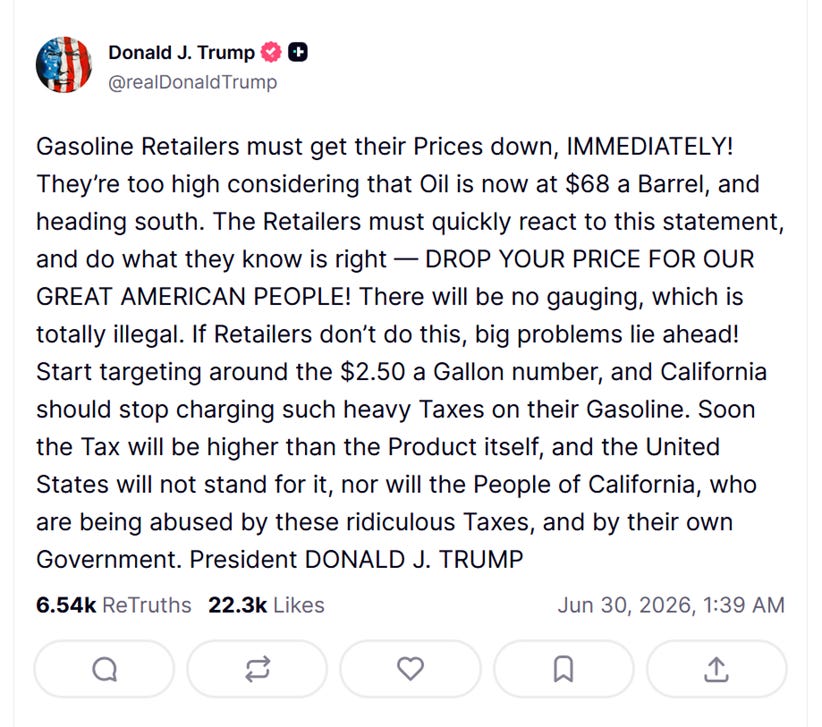
First: Consider this conundrum from POTUS
The same guy who says “Socialists are moving to power” sends out a post that spells “Let’s do some socialism for gas prices at the pump”. My kind of humor.
— Source: Truth Social
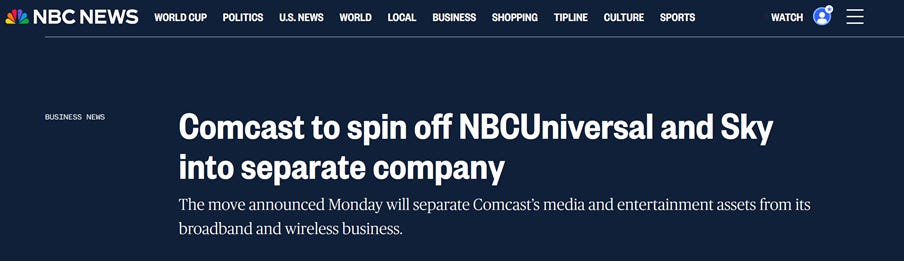
01 - Monday, June 29: Comcast to spin off Media & TelCo businesses as separate entities
--Source: NBC (out of the mouth of the horse itself)
Comcast, one of the last standing “media conglomerate” companies combining actual broadcasting technology (cable and mobile networking services) with their own inhouse media offerings in form of CNBC, Peacock, Sky (UK and other EU countries) as well as cable channels and a news network has finally pulled the trigger to try to salvage its suffering stock and set their company straight.
Just like AT&T “Time-Warnered”, Comcast has purchased itself a nice bouquet of entertainment and news media houses – last not least the legendary NBC who is a stalwart producing the legendary SNL and also owns significant entertainment franchises in Universal, like “The Minions” and many more.
And just like T, their leadership now is enacting the same bored playbook of “let’s go splitsies”.
The move is announced today and the down beaten stock has already rallied +20% as of today, so it seems pre-market traders and Europeans like me are already mildly excited about the prospect of owning two then-separate entities: Cable & Mobile Comms will be its own entity and the rest will be spun off – my bet is into “NBCU” as that is already an accepted brand name for its entertainment business in the “biz”.
What it means for the prospects of the stock itself is not quite that clear – but if we take the age-old behemoth “AT&T”, itself a result of a merger and acquisition frenzy in TelCo stocks of the 80s and – not sure how many know this – an outcome of Alexander Graham Bell’s “Bell Telephone Company”. Yes, that Alexander Graham Bell, who is largely believed to be the inventor of the Telephone communication technology, back then named the “harmonic telegraph”, as well as the refiner of the final version of the gramophone – what ultimately became the music player in the homes of the 19th century and a tech that should define music for a long time until the age of digital.
From these roots grew the Bell Company and later merged with the family-owned American Telegraph & Telephone company – and the world had its first big Monopoly!
After a nasty breakup of their initial monopolist position, they later rebranded “AT&T” - after yet more mergers in the US telecoms sector – and finally ended up thinking “what if we not only own the means of transport, but also the content?” and went on an acquisition frenzy of “media” conglomerates. After their 2016 acquisition of Time Warner, they basically owned, yet again, a significant “chunk” of the market… seems their monopoly skills were still at play.
We all know how that ended, and if not: the short version is that the company set a great example on how to become a supertanker that goes nowhere, owning a lot of “complementary” but ultimately disparate entities that would probably be way better off on their own devices without the corporate umbrella.
Long story short: T languished with their incurred debt (their leverage was insane after Time Warner) and then fell into disfavor with a lot of the old guard investors who held on to the stock for at least the dividends.
After a long languishing, they decided to sell Warner Bros. off as its own division in an equally ill-fated merger with Discovery. Different story.
For Comcast, while their size isn’t as big as T, I’d say the same story is in the books – their core competency has been, is and will be: communication services. If cord cutting couldn’t destroy that behemoth, probably nothing will – and I think their core business will “chug along” after the spinoff.
The usual playbook will be to offload all your debt into that entertainment entity, because it’s generating cash flow and leverage in entertainment seems the norm. Which was exactly what T did with WBD and then keep a high share count. Reportedly CMCSA want to keep 19.9% so a minority stake in the new NBCU entity.
The NBCU entity, then settled with a lot of debt, will have the questionable task of pulling themselves out of the quicksand based on their many ventures like Peacock, an as-of-yet money-losing but “sexy” streaming service with some great offerings like “Ponies” which still hasn’t found its foothold or voice at this point… they now have some homework to do as their mother sends them off to the cold, harsh world to discover how to make money to pay the bills. SNL is legendary but also costs a legendary amount of money. Cable networks are losing ground very fast.
It’s going to be more interesting to see if my personal guess – NFLX going in for the acquisition to bolster their waning quality with some true “ready-built IP” is going to happen.
What happens now?
My bet: NFLX (and potentially others) have already either been in secret talks or will soon be for taking the pesky media part “off their hands”.
And maybe the third time’s the charm for Netflix? They failed at Roku & Warner.
02 – The Boll Effect: “Citizen Vigilante” gets a Viral Boost by Elon Musk
These days, we can witness is the Streisand Effect in full force: Uwe Boll is not a A-Cinematographer. He never intended to be one. He always was the “Trash Man” of modern cinema. You need some trash as a palate cleanser to recognize “art”, or what people writing fancy “culture columns” label as such.
A German director only taking on topics that kind of defy “good taste” is definitely something that Germans themselves have huge existential issues with. Aren’t they the “countries of thinkers and tinkerers”? We can’t have pearl-clutching bad-taste movie makers! We can only have Werner Herzog’s crazy-artsy filmmaking and accept nothing else.
Boll filmed “Postal” and made a 90s fever dream computer game into a C-Movie (at best) – however it did capture that particular game’s bad taste pretty much and if you have an issue with that topic there’s an easy method:
Just don’t watch it.
In 2026, Boll releases a movie about another “questionable” topic:
His very controversial new movie “Citizen Vigilante” is about a “mad citizen taking revenge for killings”. Said killings in the movie’s plot have been done by … clutch your pearls now… migrants!
That topic is, let’s say of “heightened visibility” in Germany’s national security right now – so the movie didn’t get a seal of approval from its body of “Youth Protection Authority” (FSK) for movies.
While we can’t know the official wording used in that disapproval - which is the basis for denial on grounds of a panel reviewing the full movie, for context – we can only assume why it has failed to achieve a “fit for adults” labeling.
Maybe Uwe Boll will release it to the public as he promised.
Why was the movie denied an official rating? I could speculate. I think you can “put your finger” on the “why” pretty much when you read what the movie is “about”.
In the movie’s official marketing line:
A man takes justice into his own hands, hunting down criminals. His vigilante crusade makes him a social media star but puts him at odds with the local police chief.
The marketing line misses that one crucial bit that the fictional criminals are of the migrant persuasion.
So: A fictional citizen taking fictional revenge for fictional murders by fictional migrants.
If I were to take a wild guess, I’d guess it’s a pearl-clutching premise for some in “media and culture” or even worse “politics”. Maybe they can’t just bear that totally fictional premise that has nothing to do with reality?
I am sure some just can’t bear the topic’s main premise, due to the unpalatable German criminal statistics and mounting data of an inner security disaster. And yes, I’m fully aware of how the “official media” is frames topic to be totally no such thing at all. I can read both sides of an argument and still think normally without hyperventilating. I can read statistics, as far as they’re still being provided.
I don’t want to go to deep here but my personal view is: if you’re legally an adult and can drive a car that can potentially kill innocent beings if you decide to read your phone’s screen at sixty miles an hour instead of watching the road, and hence being a responsible citizen, your human brain should be capable of separating fact from fictitious content.
Now, we all know there might be some frail minds out there that are legally adult and still on the fringe of having issues with recognizing reality - some thinkers of bad thoughts might place those people mostly in political and media circles, but not me of course, because I’m an exemplary citizen of the non-vigilante kind. But if you’re one those other people who think you need to protect 99% of the public by denying the 1% of bad eggs access to media you label “dangerous”, maybe the problem isn’t the 1%?
1% of anything definitely shouldn’t be the defining measure of what you can and cannot release to an otherwise healthy public that has “freedom of expression” as per the German Basic Law (read Article 5) and after an especially dark episode of such freedom of expression stifled by the very state in National Socialism.
X & Elon Musk as the “Catalyst” for the Boll Effect
Elon Musk taking over X (Twitter) who has become somewhat of a “pariah” in “polite social circles” that follow mainstream media and believe anything they’re told so as not to think too hard. And he loves to fuel that fire – so once he, somehow, got wind of the whole affair and having some beef with the way things go these days, he just did Uwe Boll the biggest favor no Hollywood movie would ever (officially) want:

--Source: Repost by Uwe Boll himself
Elon Musk managed to get the whole movie on X.com for 48 hours (URL now “dead”) – I suppose millions have now seen the “move that can’t be officially seen”.
Subsequently, the movie was a bestseller on many VoD services like Apple TV and Amazon. It basically topped big blockbusters. Guess free marketing is invaluable, and I’m officially renaming the Streisand Effect into The Boll Effect.
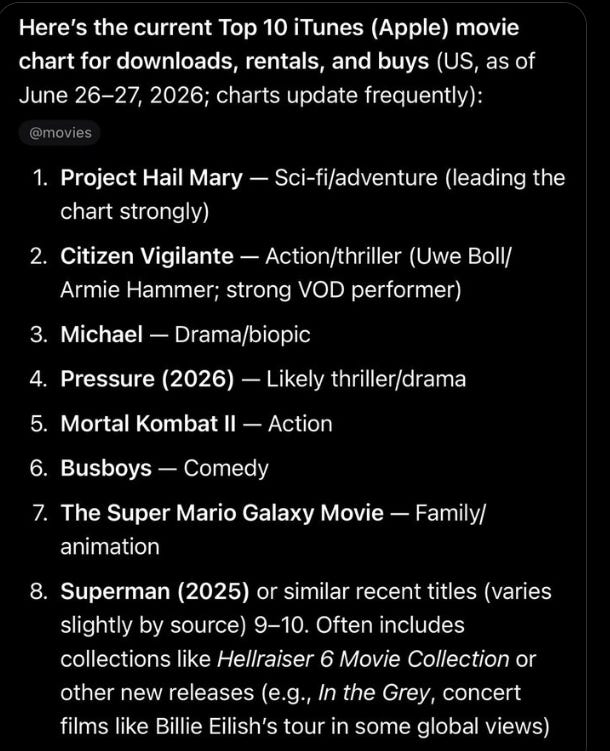
--Apple TV Charts summary from June 26-27, the weekend after the film got posted for free.

Share this with anyone who loves “banned” movies and hates free speech.
03 - The Government as an Investor - what can go wrong?
We know now that the current U.S. government loves “choosing winners” in the stock market. If you happen to know that the Unites States, with its infinite money printer via the Treasury, can “take a stake” in a publicly traded company you better believe that it will influence stock prices.
Lucky you if you happen to have a magical “spidey sense for stock picking” and were on the right side before the announcement! Maybe you should play power ball as well?
Not only did the Department of Defense hand out contracts to buy Drones, refill their depleted missiles and munitions they shot up the Strait of Hormuz. The Department of Energy also mounted a veritable “Investment” cycle in critical minerals that somehow ended up mostly being controlled by the Chinese due to literally being “dirty business” that the western world swore to offload to others to have their “Green Deal” fantasy for about the past 25 years.
The chickens had to come home to roost one day, and so the collective west has to play “catch-up” in case they want some autonomy with their resources or energy - as the U.S. is currently pursuing with verve. For oil and gas, they were already there ever since the first “fracking” well enabled unlocking way more than they’d ever need. For minerals, metals and all-decisive “rare earths”? Not so much as the permitting of mines and “dirty business” was shunned in many states. You could almost say they’re as bad as Europe in that regard - but what they do certainly have as opposed to most European countries is the resources themselves. They just would need to “develop” and build, baby, build.
All this, while being necessary indeed for national security, has left a bitter aftertaste on the public in form of deals, mega-deals and bigger, year-long development and offtake agreements struck across the raw material chain of modern war materiel and industrial input production.
The latest big fad, “AI” - aka LLMs run on massive power needs being fed into massive data centers – is now on the front stage of the economy. You could say if the AI trade stumbles, the economy might take a fall. No earnings call where “AI” doesn’t creep in to make sure the public gets that the Company is also embracing it, even if they make toilet paper.
AI eats world. And it also eats power, water, resources and money. Loads of it. All while displacing workers in the initial waves that we can already witness – at least the official wording of massive layoffs often has a mention along the lines of “we’re setting our business up for the future utilize the productive capacity of AI to reduce costs”… meaning an AI now runs Clorox’ toilet paper procurement by the sounds of it:

It might seem weird then that their stock ($CLX) literally tanked throughout the year due to “Staples” being in the doldrums in our current “greatest AI economy ever”.
Workers that still have one may also begin wondering: will I still have a job next year?
Governments usually sleep all through the early innings of such “disruption” events – potentially until surprisingly angry mobs take to the streets and demand decisive action. But even the usually sleepy U.S. government has been mumbling in their own complacency recently and initial temperature testing about “socializing losses but privatizing gains” are rising. Klover.ai has a whole report on the issues arising from OpenAI as a public company, in relation to its “dangerous models” that are now still under “non-profit” guardrails, as we’ve seen with the recent “hold” issued by the U.S. on releasing Anthropic’s Mythos model family to the public - that would be more hard to do if those companies were public and their revenue were impacted based on an arbitrary ruling of your “model being too powerful for public use” (whatever that means).
While profits currently are nowhere near for neither Anthropic nor OpenAI, this puts the question of “who’s making all the cash, then?”.
If we look at the massive CapEx spend on “all things AI” and at the crazy market distortions normal people are now seeing in memory products and GPUs – products that are needed as picks and shovels to make more AI “vibe code”, which is killing off junior coders and making the whole drag of getting a CS degree somewhat of a potentially “moot point” in the near future. Maybe some AI-generated cat pics to “hang in there” will appease workers before their jobs are made redundant?
But really, who’s making all the money?
Right now: it seems almost no-one outside of the sellers of the picks and shovels, if we go by this:
Massive debt is taken on by “private equity” and now bleeding out into pension funds and life insurance portfolios – maybe unbeknown to owners of pensions and life insurance.
What happens if the whole thing “goes bust”, as they say?
Well, losses would be taken, CapEx written off worthless – and yes, those debts would default with a higher likelihood than AI currently has to solve it’s own problems.
So: OpenAI’s going public is somewhat of a contrite point after seeing SpaceX go “first” and call dibs on all the public euphoria on “investing in the future”. Sam Altman has been on a tour de force to convince everyone OpenAI is the next big thing right after SpaceX – and their IPO seemingly vital to surviving their cash bleed.
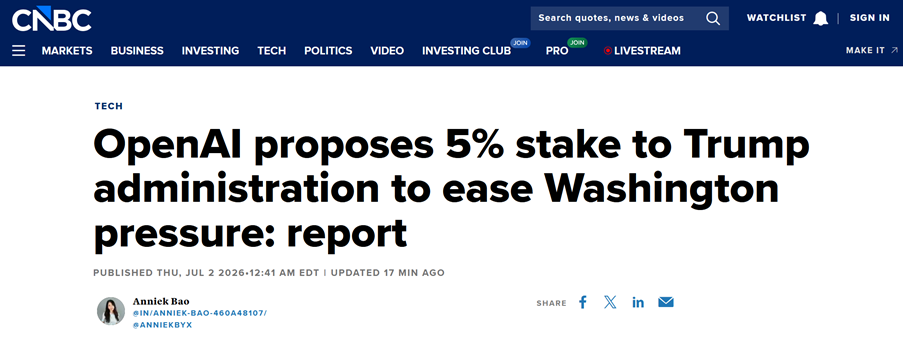
He must have looked at what the Trump administration was doing to all the miners, rare earth refiners and chip makers like Intel, AMD and Nvidia: they could take an official “government stake”:
--Source: CNBC news coming out of the FT insider report (Jul 2, 2026)
OpenAI CEO Sam Altman argued that giving the public a financial interest in the company is the best way to share the upside of AI, the FT reported, citing two people familiar with the talks.
I have read probably the best analogy you can ever create to compare:
That’s like taking a stake in one football team and you’re the referee.
— Anonymous on reddit
Any and all companies where the “U.S. has taken a stake in” are now a de facto state-furnished business with a big advantage of the backing of the all-mighty U.S. of A. That might also mean their stock valuation has nothing to do with how well the company itself might actually do for as long as Uncle Sam is “in”.
Stock prices exploding after the stakes being laid open was the public “rushing in to get a piece of the cake” – which might ultimately to prove only sweet for the few exiting their earlier-taken positions while you are now officially the bag holder.
And those are some heavy bags if anything goes south from here and you don’t happen to be blessed with the Luck of the Irish or a magical 8-ball that actually works when you ask it “should I sell Intel now or does it go up more?”.
04 – SOXX Watch & Market Update
As a reminder or to new readers: SOXX (The Philadelphia Semiconductor Index) is a great proxy to watch the “AI Trade”.
As such, I have been monitoring this for signs of weakness.
And they just might have been turning up – as you can see in the following 3 snapshots.
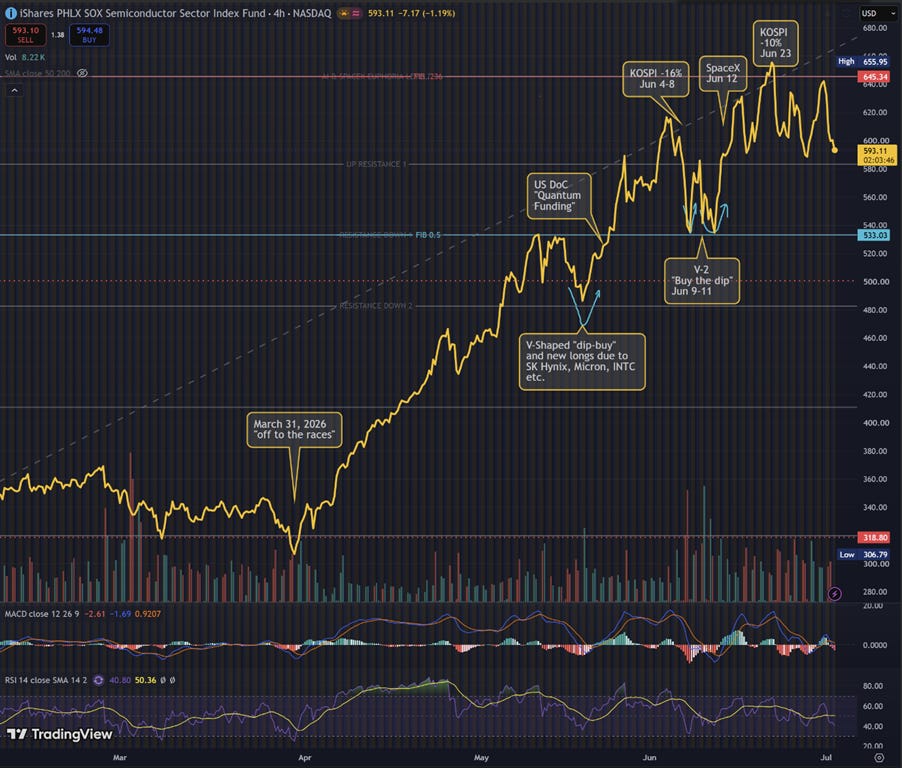
--July 1, 2026 4h line chart - SOXX – Initial “downturn”
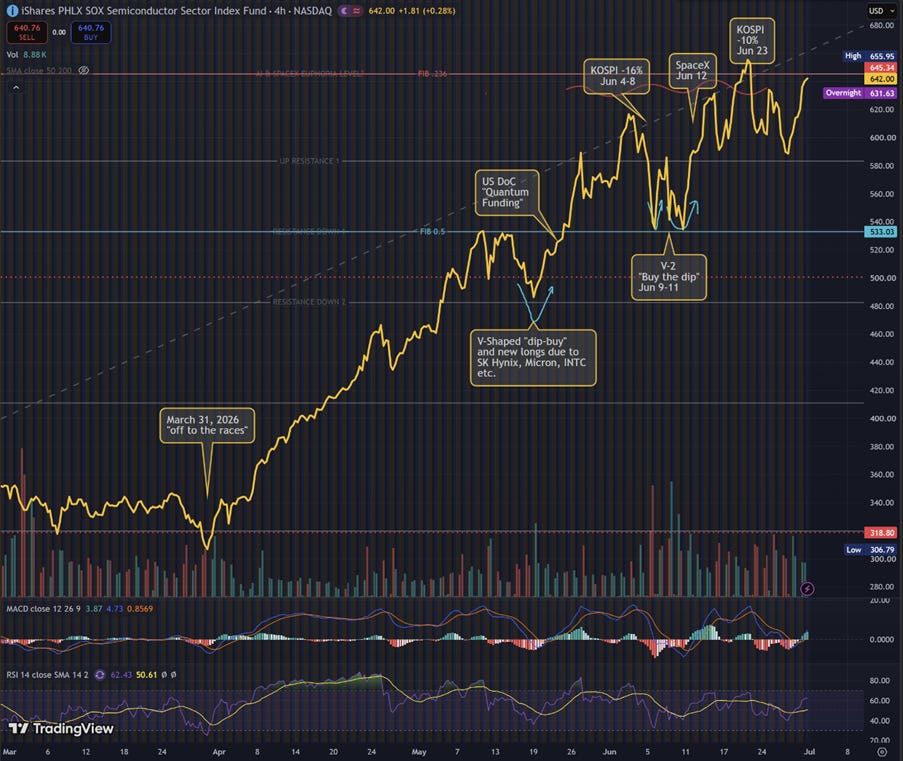
-- Jul 2, reflective V-Buy-the-dip on the day and a rebounce.
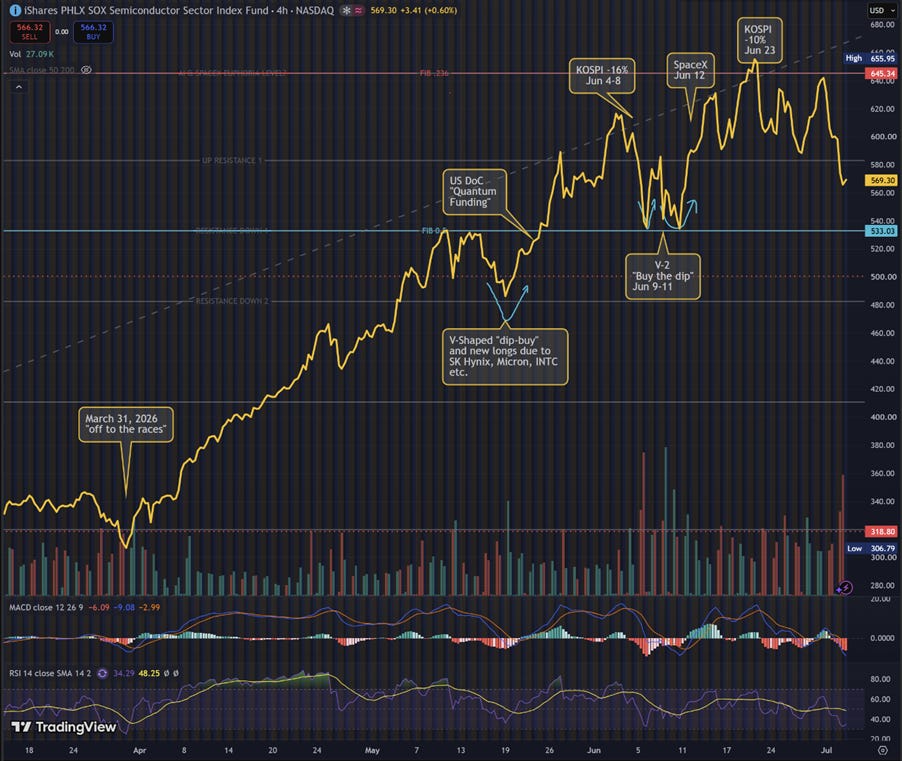
-- Jul 3, failing to make a higher high and rejected yet again at the FIB .263 line (FIB measurement by myself)
This is not a conclusive “that’s the top” by any means, but the signs are mounting and if that FIB .263 line I drew does not get thrusted through my personal view is it’s over (for now).
Let’s not even talk about valuation metrics of the stocks involved in this index – the worst offenders for a downturn right now were: Samsung Electronics, SK Hynix, Micron… and everybody’s initial darling and hype leader, Nvidia: the stock is stuck in a downward spiral and never made a new ATH ever since, maybe the strongest reminder that all parties come to an end?
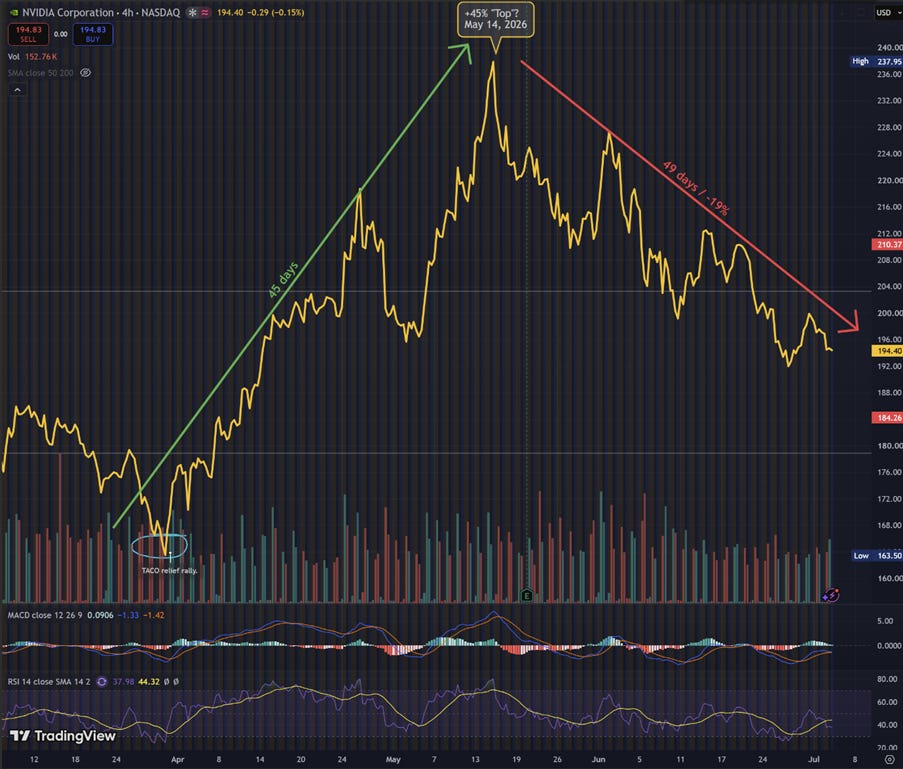
--NVDA 4h line chart, Jul 3, 2026 – the stock is stuck in a down trend ever since May 23, 2026.
Maybe Nvidia’s Jensen Huang finally gets to have his Icarus moment – he certainly would benefit from a healthy dose of humble pie:
From Dwarkesh Patel Interviewing him extensively (transcript here, this section begins at this timecode) – asking Jensen about the “moat” and if “selling to China is vital” is where we could see some cracks in the veneer:
Jensen Huang
We have to keep innovating and, as you probably know, our share is growing, not decreasing. The premise that even if we competed in China, that we’re going to lose that market anyways… You’re not talking to somebody who woke up a loser. That loser attitude, that loser premise makes no sense to me.
He definitely met with Trump too much, that’s using three losers in one sentence.
And I have a guess as well on why that made him lose his temper for a bit. “Banned” cards have been sold extensively to China via smuggling. There is a huge black market in China for these banned cards – that’s why they are so scarce that you barely can get one – let alone for “Suggested Retail Price”.
Cases are being investigated by the U.S. based on this and arrests have been made on some former distributor executives who seemed to be involved in facilitating the sale despite extensive “technology bans by the U.S. Government.
So obviously when talking “selling to China” with the then still active ban that has been circumvented by smugglers that rose some ire.
Once the collective mania dies down – for whatever reason – or the moment the veneer in the allegedly “unstoppable” AI complex cracks, I’d suspect some sad faces.
People will have bought in at excessive levels, providing liquidity for those who have held to make the majority of those gains. That last 45% “hump” that you see above might well be “it” for the foreseeable future on NVDA.
How much more revenue do we think they can squeeze? Another +500% year of growth? Then one more? At that point, I’d figure the world’s supply of graphics cards has been literally sold three times over and you’ll get vertigo from all the circular deals getting called in.
Let’s see if Summer will put a dent in the trade or if it’s just a pause before more gains – usually trends break when you least expect it so we might see another melt-up after all the ones we’ve already seen.
But I’d be very amazed if the permanent high plateau we’ve all been reading about is here all of a sudden.
