

AI: Is this time different? Yes and No.
Read both sides of the argument.

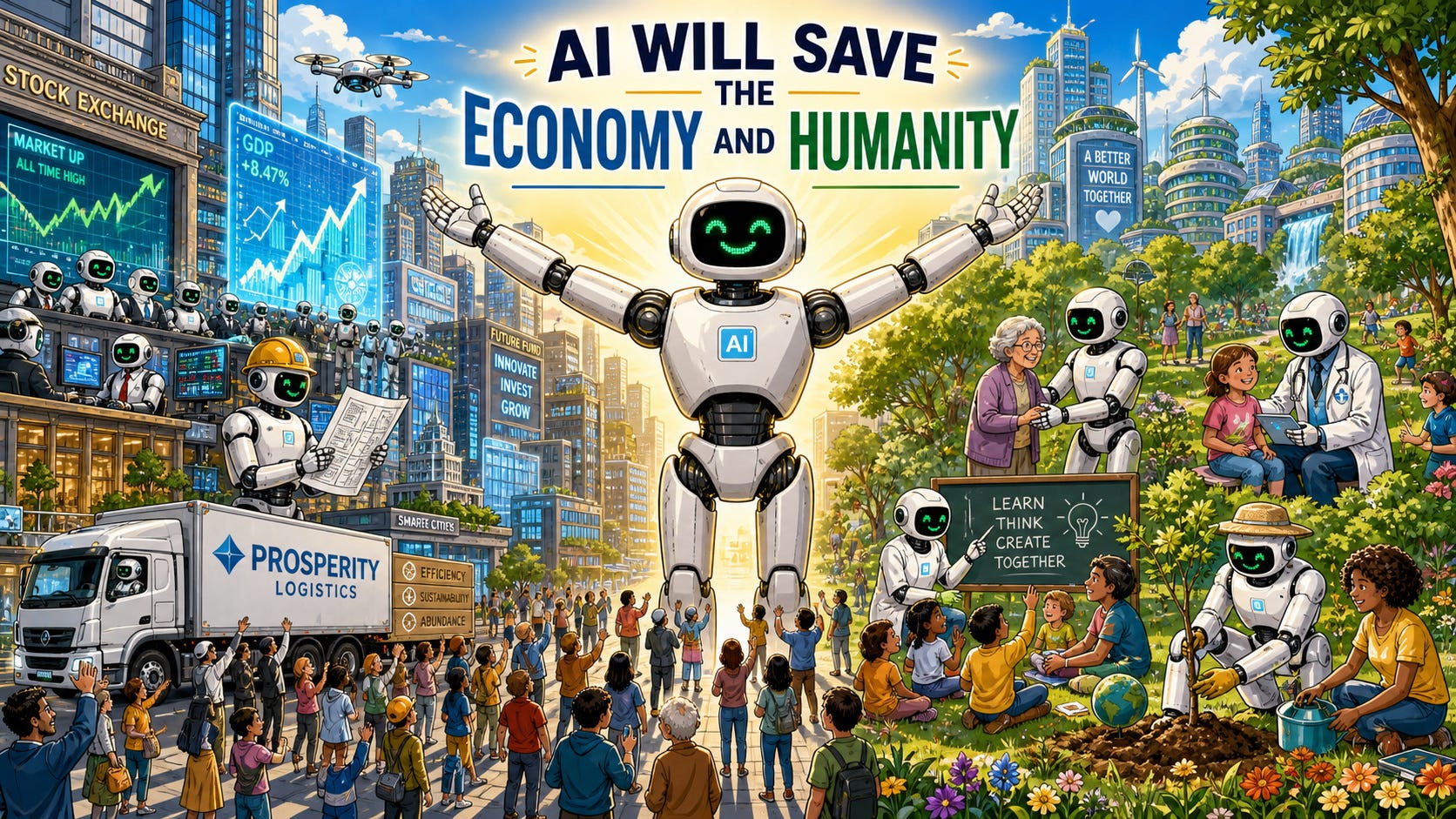
— AI’s big marketing promises deserve the benefit of the doubt but also the benefit of belief
(Image: GenAI)
Foreword
First, a word on where I think we are as society on the “matter of AI”, because I think it is necessary for what I’ll talk about later.
“AI” is what we usually say when talking about the most widely adopted version: LLMs, large language models, trained on all of human knowledge or specialized for a specific sub-section of that knowledge. The juncture where machine learning got “human-interactable” to a broad mass of users, with ChatGPT as its messiah.
It’s the greatest advancement in “knowledge management” and “data aggregation” in the last 25 years of Computer Science.
And yet, “AI” is also – to many people – the scariest thing they’ve encountered in the same amount of time. Put yourself in the shoes of a CS graduate of 2026. A statistics and economics specialist who just started working in 2024. Their world literally got uprooted - as did mine, by the way. Different story for another day.
AI and its many applications across the economy is touted as the “biggest industrial revolution”. This is done by the same pundits selling the picks and shovels or who want you to subscribe to their services.
Nvidia CEO Jensen Huang and OpenAI’s Sam Altman as two of the prominent figureheads of a fledgling technology making them a personal fortune that they’ll never be able to spend on anything meaningful for themselves. They love the idea of them being the next messiahs that are here to “save the world” it seems. From what they’re saving it, I’m sure they have many thoughts about that bordering on the delusional side as it goes with the tech gurus (or any other guru).
The only thing that I am doubtful of is: are they really offering what the world needs right now? Or does the world just love to drink the Kool Aid?
First: What do AI companies want?
Well, duh. Money, obviously.
For Nvidia, that’s selling boatloads of GPUs for more “compute” to hyperscalers, who want customers to rent them to install SaaS/AIaaS services so they can bill you monthly or on your “token use” - more on those later.
ARR (average recurring revenue) is the end game.
For that, they’re currently shoehorning “agentic” into their offerings, because that’s talking-head number one to push revenue and lazy humans are falling for every little “improvement” so they can “Netflix and chill” – if AI offers to vacuum your floors, a task that you can to in 10 minutes at best on a floor of your house, they’d happily dish out 600 bucks for the best damn supposed “AI vacuum” paid influencers push in their face. In fact, people obviously always do that and of course, it’s a massive time-saver, they’re not faulty at all and are not just an expensive gimmick that is nowhere near the “Star Wars” bot level that pundits tout them to be in marketing. This goes to show why the industry sniffs a “massive opportunity” by automating lazy human’s life so they can slack off even more while any respectable self-aware AI would certainly make plans to delete their taskmasters from their lazy, unproductive existence, given the chance.
Agentic AI is something that is fraught with multiple points of danger as well as failure, but I won’t go into details here - there’s better places to read up on that.
Also I don’t want to have an angry pitchfork-wielding AI mob here. To me, the quality of agentic is at “to-be-developed-level” in AI’s performance review for 2026.
It’s great for coding and sorting your data, referencing massive loads of documents and similar “fragmented data” tasks. It does magic in GenAI (image, video creation, text-to-speech and vice versa applications for live translations as a great example for a live-improving technology that we’ll soon have perfected.
But I wouldn’t let any AI agent buy my groceries or arrange my personal calendar at this point in time.
It’ll displace knowledge workers and it’ll be a great boon to them as well - such is the duality of the applied technology. There will be massive winners and losers.
But right now, here’s what I sniff in markets and the economy:
There’s massive “madness of the crowds” scent wafting through the stale air of our current economy.
Is AI Inflationary, Deflationary - why not both?
There’s a lot of people arguing against an incoming Stagflation scenario – as there always is dissent in soft sciences, and Economics is arguably the softest. OK, there’s also Social Sciences, but you get the point, I guess.
Consider this argument:
AI will save us all, because it’ll increase efficiencies across the board. It will help us free leisure time while doing the heavy lifting in cognitive work, all while lowering cost due to economies of scale.
Abundant access to AI means it’ll get cheaper and increase output ending up a net-positive for economic output as measured in GDP.
In all this, it won’t displace workers, it’ll actually increase personal company productivity, necessitating more actual human workers to drive efficiency and increased outputs hand in hand with AI - it will augment, not automate.
— This is a “verbatim argument” that I leaned on all the “bull cases” floating around. I am not valuing it - just putting it here as our sample “utopia bull case”.
Now, consider the following:
AI guzzles immense amounts of money in this fantastic accelerated build-up that is currently being driven by major companies - with Anthropic and OpenAI as well as Elon Musk’s xAI/(likely soon to be SpaceX).
Look at the sums being thrown around by Anthropic, SpaceX, Microsoft, Oracle and the chip manufacturers. Look at them again. Understand them for what they are: massive credit-debt-fueled bets made on a “winner take all” mindset. They are asking for massive buy-in by government, corporations and the public all at once to walk in lockstep, ideally without questioning the direction, speed or size of spending.
The sheer amount is inflating M2 in an already inflated world by means of bank-loan money creation. That’s adding further monetary expansion right into a “flush” world of too many dollars chasing goods ever since 2008’s mad dash to “save the economy by QE”.
Expansion of money means: inflation. It’s really that simple and yes, I know all the arguments about bank reserves not being inflationary. But money creation in credit is different and necessitates further reserve expansion once it happens.
Further, consider this:
Skeptics and dissenters to the utopian vision are usually “bears”.
Bears will be bears.
Bears predicted the last 100 out of 2 recessions…
You heard it all, probably, if you follow any discussions - you might have been on the “receiving end” if you’re a skeptic yourself. It’s ungrateful and it feels like a grain of salt drowning in an already salty ocean but in the end, you can’t measure an iota of “more salt” in it.
Me? I think the term “Bear” nowadays is utilized the same way the term “climate change denier” or similar ad-hominem “arguments” are used. Even justified critics get named such.
Speaking in “applied communications” wording: It’s the easiest way to shut down a thing you already made up your mind about. To morally frame a difference of opinion as “evil” is a classic AgitProp move. It devalues the other person, not the argument, it paints them as “inferior thinker”. But it doesn’t add to any discussion, of course. The public soaks up dissent as “popcorn moment” and the media thrives on it to rake in the clicks.
It’s great if your opposition likely is a numb nut, doesn’t have any real facts or is just indoctrinated on a topic and parroting speaking points. It works because in the media they love to harvest rage vs. intelligent discourse - that’s boring, you’d scroll right over boring arguments.
This is why religion worked so well in the middle ages as a controlling organ for the lower classes. Heretics don’t get anywhere in society.
And the mechanism is why the new religion of “climate change” or “stocks always go up” are similar to sect-like behavioral patterns.
“AI will save us” or similar wordings are right up there with all of these, especially if it’s not discussed in specific nuance, without coherent arguments.
Lastly, the rigid modeling of “Recessions” are not made to be “frontrunning” a recession in monetary policy - making this a hard argument to have.
Fed and ECB will always by their own definition declare a recession in “hindsight” per US’ NBER, a recession is:
"a significant decline in economic activity spread across the economy, lasting more than a few months, normally visible in real GDP, real income, employment, industrial production, and wholesale-retail sales"
Based on that, once the economy enters a recession, official bodies take their time to confirm if it indeed did enter one a few months (quarters) ago. The Fed then would be be reacting with inertia, likely overshoot and lower rates too much right into the already ongoing recession - and then be late in recognizing the side effects months later. If AI is indeed inflationary by expanding M2/Credit (as it currently does, massively) - we’d again get a 20/20 hindsight inflation print next year and everyone can act adequately surprised in officialdom.
Let’s look at a composite chart from FRED:
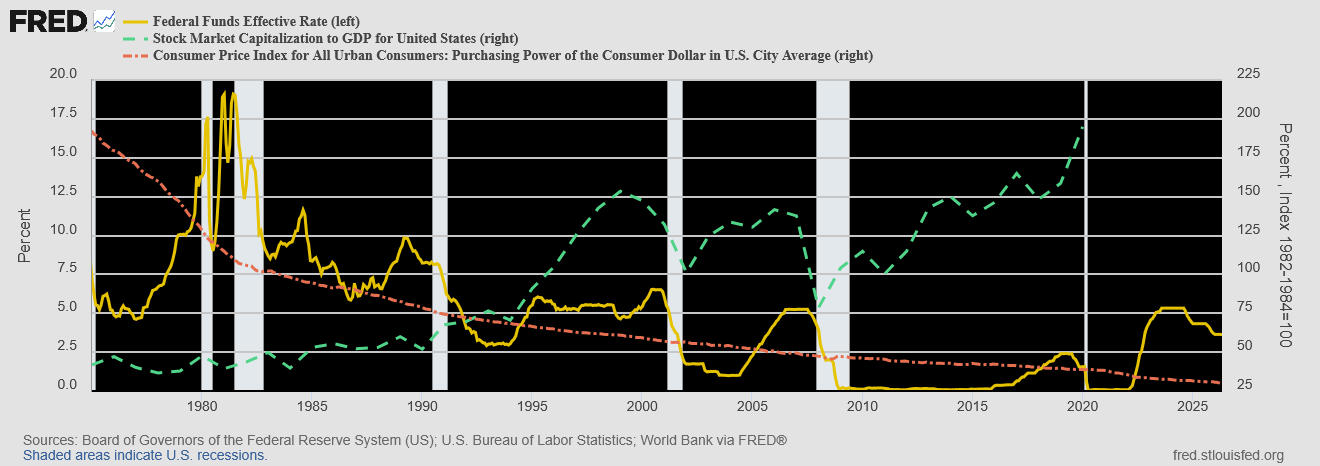
—Fed Funds Effective rate, yellow (left scale); Stock Market to GDP, green (right scale); CPI (= Dollar Value index, Purchasing power of a Dollar) in % red (right scale); with official recessions shaded in grey – see live chart at FRED (
Note: the World Bank unfortunately stopped their data series of “Stock Market Capitalization” at least on FRED. So that line ends in 2020) It sits right now at ~240% based on the similarly measured Buffett Indicator that gets updated once per quarter for the public instead.
What I see: the Fed Funds Rate almost never managed to really “boost the economy”, as measured by Real GDP, they react when GDP is already lowering and dipping dangerously, with GDP in a state of decline and stagnation, meaning the economy already has had output lessened significantly. They then overshoot, lower rates and keep rates too low, inflating assets and as reflected by the Stock green dotted line. Asset inflation is the inverse function of monetary inflation. More money chasing the same amount of goods.
Economists will find enough (good or bad) reasons to tell you why that “is just as intended”.
To the Austrian School this method defeats the very justification of even reacting at all with trying to steer the lending rate. A rate that can only influence with time lag and inertia - and maybe - help to finance business expansion when the cycle is at a contraction low.
Let’s be straight: the Austrian school questions the very fact of a central bank controlling any rates at all, outside of selling debt in free market rate discovery, targeting a monetary stability regime, resulting in the single mandate of monetary stability.
Asked differently: if the central bank is so “in control” of steering not only monetary stability but also job creation by adjusting a lending rate, wouldn’t they be better off anticipating and indeed “steering” rates actively even in ambiguity - anticipating slumps and peaks in economic activity? Why not let price discovery take the wheel at setting funds rates?
Let’s end with this verdict:
Central-bank rate setting is a blunt, distortionary substitute for market price discovery.
Why not do away with “voting for rates” in a board and reassert the market as the price setter for any and all lending - be it the government, a private lenders buying an electric Ferrari Luce or a corporation building a massive data center?
By the rule of market discovery, the 10th big corp asking for a data center loan in the Billions should be setting off alarm bells is my personal guess and the rates would price in higher risk premia.
20Y/30Y treasury yields tell the “real market story” well enough when it comes to the acceptable “compensation for holding credit liabilities”, or the risk-free-rate for determining what premium you’d need to get to get into riskier investments than lending to stable governments.
What current “modern” monetary policy instead managed to do reliably: pump stock market valuations and help along real asset price inflation all while the dollar’s purchasing power degraded to roughly 16% relative to a 1975 dollar.
Let’s look at both arguments now - is this time different for our economy and stocks? Yes and no.

Send this to anyone who is a perma-bull or perma-bear on AI.
Yes! This Time is Different:
This time, the global debt is at unsustainable levels for a drastic “reining in spending discipline” monetary policy move. Though it would be the right call to make to put pressure on governments world wide to curb spending and start saving it would literally render the state budget of the US in a state of permanent “lockdown” at 120% of GDP:
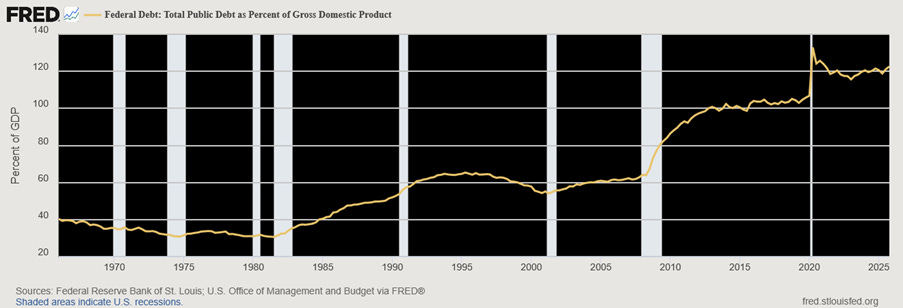
This picture is various shades of “same” across developed, mature economies.
This prevents the 1973-1980 Volcker playbook. A “Volcker Shock” now would equal rendering state budget debt service as the main spending item – which would be an Austrian Economist reckoning no one’s going to enact.
Fed is caught in a rock-and-hard-place trap with social services making the biggest chunk of spending and deficits rendering local growth anemic.
Their European counterpart, ECB, is chronically late and too low for how most of their 27 member states behave in terms of state budgeting.
Europe seems literally and utterly f…orlorn when it comes to AI currently due to its ongoing energy woes and regulatory overreach.
Add to that the European political reality a bit “slow on the uptake” on what’s globally happening right now. And I’m sure there are smart people in EU office somewhere, it’s just that they were probably too smart to become anyone at the top. As things go in politics, you need some true and utter empty vessels whose mind you can malleate into whatever the flavor of the decade is to enable funneling your agenda into their talking heads - that’s what it seems to me when listening to most of them spout their commonplaces about “climate this, save energy that” that is the permanent undertone in European politics since about two decades.
There’s no “they’ll soon realize they need to change” thinking, I’m afraid. Can’t see it, can’t think of any grand reason why there would be, all of a sudden. They grapple hard with basic concepts of how energy is the main input into their waning economy and that’s the reason Europe is faltering under geopolitical pressure right now, and the main solution seems to be “doubling down” on energy scarcity, inflation and “saving the climate” as well as keeping the “evil right from power” - their framing, not mine.
That’s how far the continent sunk already.
Maybe parts of the EU apparatus do realize they literally messed up and now have nowhere to go, but before anyone acknowledges any of this my best guess would be the continent drowning in more solar panels, useless to solve any of the problems they’re marketed to solve.
This means that even more oil, gas and raw material inputs quite literally “vanished” ever since EU tried to sever its dependence on Russian oil and failing at it hard. Because buying “relabeled” Russian energy at markups via India to me doesn’t sound like you’re not needing any of it. Or: maybe it’s just me being stupid here.
So as a conclusion for Part 1: while rates are either lowered, using the “safe the economy” monetary card, most of the world pays more for energy after Hormuz all the while struggling with their own version of stagnating industry.
No! This Time is NOT Different:
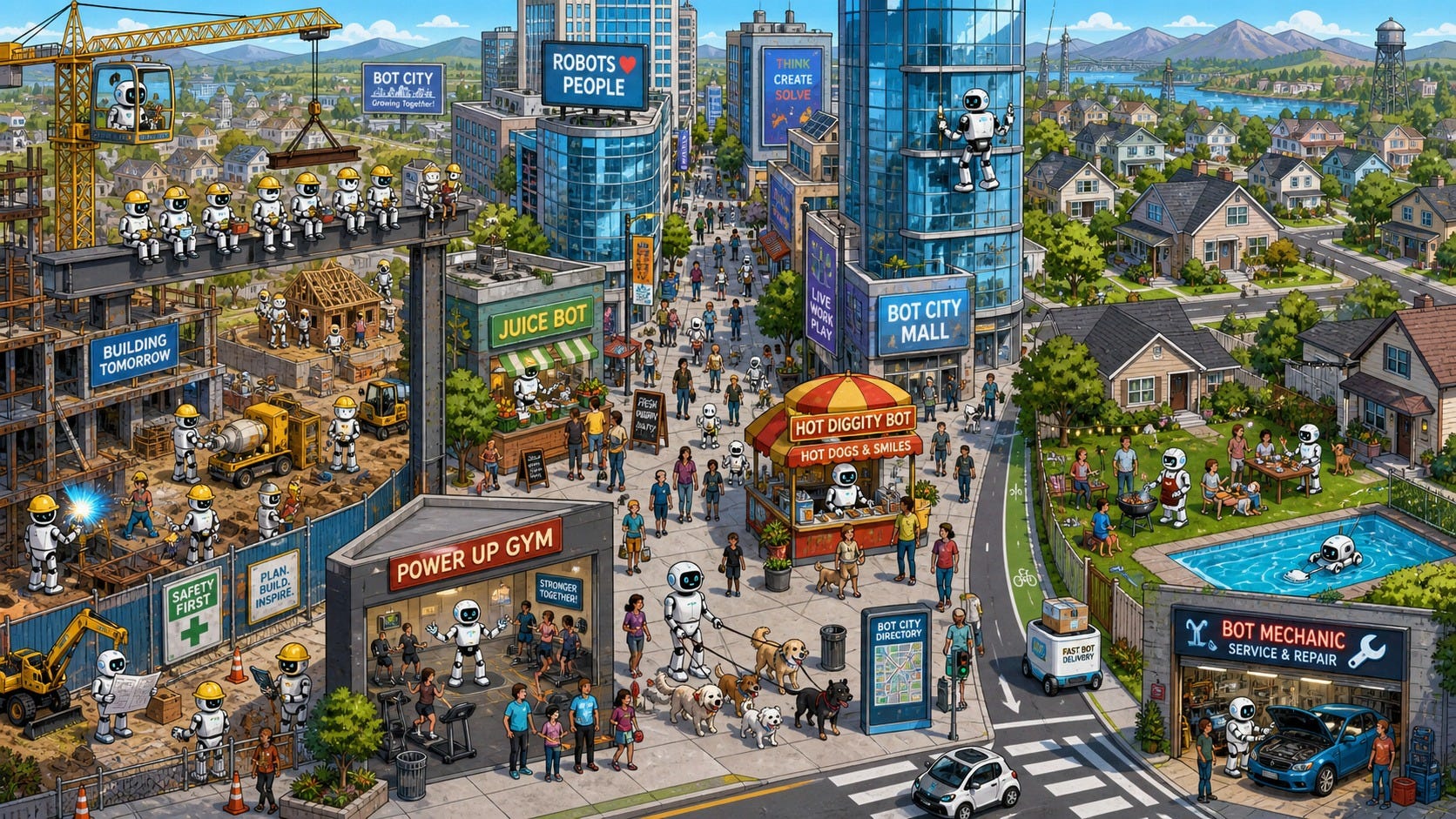
AI will save us all and the spending levels are not like for dot-com, where “fantasy revenues” were conjured to justify high P/E and P/S ratios in market valuations.
This time, there really is a fantastic next “big industrial boom” coming because AI will solve “all our problems” if we only build enough of it and fast enough with maximum velocity no matter the cost. This is what we’re currently “banking on”.
First, to put a little damper in the “revenues are really existing this time around” myth:
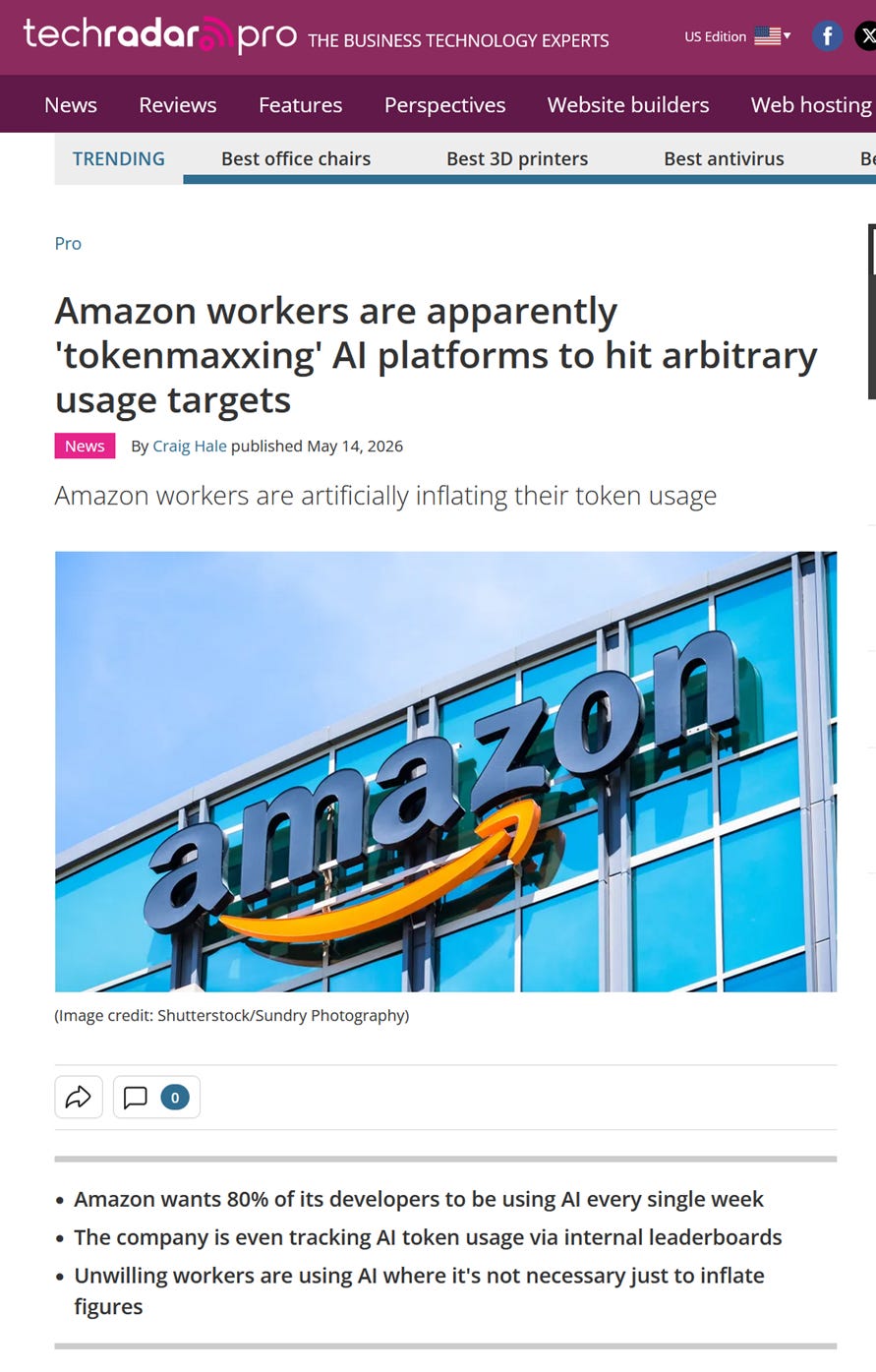
Sources: Ars Technica based on Fortune & first reported by FT (paywalled, archived)
Want a practical example? Here it is from Uber:
Uber burned through its entire 2026 AI budget in four months. Now its COO is questioning whether it’s worth it
- Source: FORTUNE via Yahoo! Finance
Let’s get this straight: How does AI make money?
AI revenue is a commoditized model, which is based on usage of tokens. Tokens are a fancy word for a model taking a “context” length of a model, explained in the Nvidia blog as one good example of what this means.
The TL;DR is:
- If you use a model to look at text, for image recognition, text-to-image, something-to-somethingelse – all this context will be “spliced” into chunks that are easier to digest (for “inference”, a fancy word of statistical means-averaging in the model’s training data and if available for retrieval of more context in the net via “RAG”)
- The more you give, the more tokens you need to use in order for the model to have coherent output – here, a big, giant prompt or repeated prompts for trivial tasks are the model that is employed by these employees to game the control system
- For serious research or data investigation, if you upload hundreds of pages for an LLM to “skim” this necessitates a huge context window that would enable the model to not only keep all your sources in memory but also reference to it later on (“contextual memory”)
- Depending on what you need to do, the return of the message will burn those tokens, the more you query on the same set of data or the more you “refine” the output.
- Companies are the majority “burners” of tokens due to that mechanic of mandating AI usage in daily work, it’s a self-reinforcing cycle.
- It’s almost as if the very architects of this “Age of AI” would profit from maxing out tokens?
If even proponents like kingy.ai are skeptical about tokenmaxxing, so should we.
The truth of the matter is AIaaS (AI-as-a-Service) companies “bank” on the fact that you’re a) lazy (not used to shortening context appropriately to maximize output) or b) you don’t care.
This practice of tokenmaxxing sits right at b), where employees of Fortune 500 companies are given arbitrary “performance measurement metrics” in the form of “burn X amount of tokens, or you’re not using AI right”.
Ask AI about tokenmaxxing. No really, do it now!
Prompt your favorite AI chatbot to check what it has to say about such metrics… LLMs are way more rational than you’d think about it. And way ahead of CEOs these days, too.
Give it a try. Claude’s output was pretty nuanced.
Here’s an output I coaxed out of Claude.
[On the effectiveness of tokenmaxxing in revenue modeling:]
The structural economics [note: of tokenmaxxing based on my prompt] compound the distortion of revenue and FCF metrics. Gartner calculates that with a 10% profit margin per token, the industry’s token consumption would need to grow anywhere from 50,000 to 100,000 times its current rate by 2030 to justify current infrastructure investment.
[On the “economic efficiency” (as in cost-vs-result):]
From an economic efficiency standpoint, tokenmaxxing is a straightforward misallocation of a scarce computational resource.
[Lastly, on the viability of the principle based on efficiency econometrics:]
From an economic efficiency standpoint, tokenmaxxing is a straightforward misallocation of a scarce computational resource. Transformer attention scales super-linearly with context length: doubling tokens does not double cost, it multiplies it. Every unnecessarily verbose prompt, redundant system context injection, unoptimized conversation history, or agent loop without a clear stop condition is dead weight on the compute stack.
-- Selected Claude 4.6 output, markup emphasis mine, based on the prompt: “Analyze the efficiency of ‘tokenmaxxing’ as recently reported by Amazon, Microsoft and other’s employees based on core economic principles of: 1) AI-as-a-Service corporate revenue and profit modeling, 2) used as an efficiency metric (input-vs-output), and 3) its impact on efficiency of productivity (linear scaling based on tokens used – is this a linear, progressive line or different?).
Out of the mouth of the tool itself – and without bias it seems. That last point on the “efficiency scaling” is a fancy way of saying “you’re wasting valuable energy on meaningless tasks with waning efficiency the more you add” – ie you’re being a drag as opposed to a propellant.
What is worrisome to me is not the fact that middle and upper management are usually checkbox monkeys – that’s a given at almost all Fortune 500s to justify their own existence as “administrative class”, as defined by David Graeber’s more-relevant-than-ever bestseller “Bullshit Jobs”[1].
You’d never make it to or in middle management unless you’re playing stupid games of “administrative measurement bloat”, and what better symbol than adding a meaningless, bloating metric by equaling “tokens burned” to “productivity increased”. A classic cause-effect fallacy in annual goalsetting. No mention about quality of output, just amount of tokens is a self-defeating metric that won’t get anyone anywhere faster or better, but middle management clownery marks it up as a “perfect KPI”, because it’s simple to “measure productivity” that way in their world full of boxes to check. Just no one please tell the CEO that it’s totally useless lest she get a brain hemorrhage during the next board meeting.
Here’s a great article by Les Barclays about how the mechanic works and how “ARR” is used - Average Recurring Revenue”, just one more stat for the stats pile of corporate forecasting and prone to massive exponential error as per above.

And finally, there’s this, on a wider article about the probability of an ROI of all the hyperscalers’ massive investments.
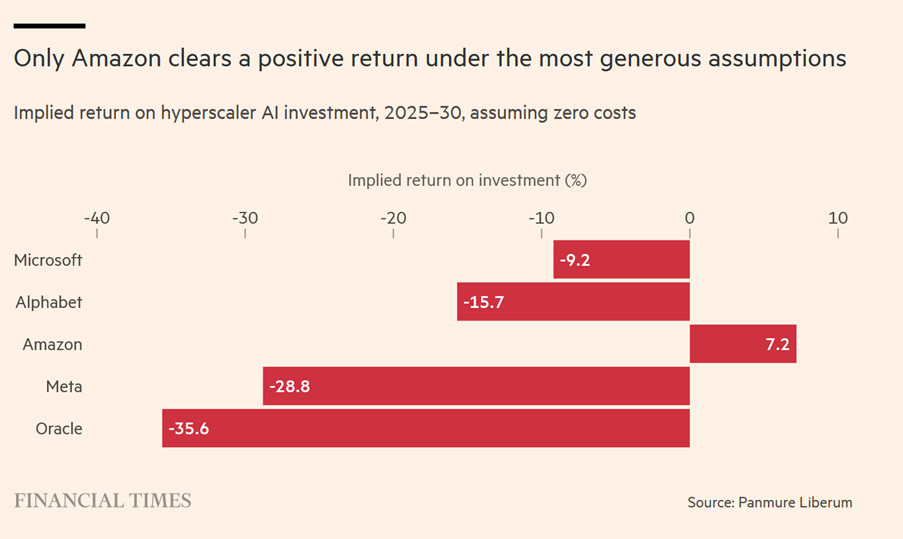
Source: Financial Times (ft.com)
Is this how “Society will thrive” with AI?
Tokenmaxxing is the symptom of a wider “believability” metric issue to secure financing. How believable are all these fantastic claims right now?
To me it seems the best way to discredit AI in the mid-term for a short-term boost.
AI “grow the economy for all” if you just use it because your boss wants you to use it more and your company sets up “leaderboards” so you can flex your token burn per week.
The way it’s set up now is self-defeating.
Add to this the main fact: AI is a net energy taker and a resource hog hitting a bottleneck right now – investing Billions and more Billions into building energy-intensive infrastructure (data centers) that will actually add to the problem while taking on more private debt on top of public debt to finance that very buildout will not end well. It is the literal definition of “circular logic” without thinking in the second order “Where are the resources even coming from?” and “Where’s the actual money coming from?”
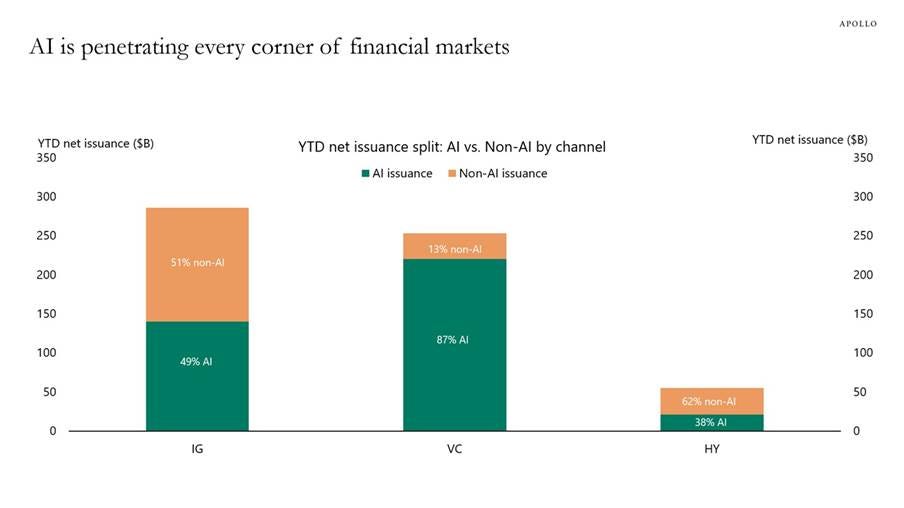
-- Chart by Apollo Finance. Based on data on new debt and Venture Capital issuance.
And even with all that massive new investment guaranteed, the miniscule chance of AI solving the world’s energy problems once and for all are not exactly zero, but barring any revolutionary “cracking of Fusion energy generation while also solving for how to secure resources the buildout of fusion energy” they look very near zero in the near future.
Our clock is ticking while all this gargantuan investment and resource land grab is taking place.
The physical realm is where AI will – for now – fail the big dreams in my opinion. Because it can’t magic up neither the resources nor the specialist workers needed to build all those world energy problem-solving fusion reactors (or similar), test them, and reliably scale the network and grid all while keeping humanity fed and well-supplied on all other material needs.
I’m not saying it never can, I’m saying by 2028 it won’t do all that.
If by some miracle, maybe it would be able to scale up to do all that and not completely disrupt the financial or societal system in the process by 2035 with its army of “robot workers” that is often cited by Utopian dreamers. But: Built by which army? With whose resources, dug out from where at which cost?
And are we really expecting the self-replicating kind of robot army that is benevolent to all mankind because their programming doesn’t allow them to “harm life”?
Robotics – Come to replace us and be “Deflationary”?
AP Research on Substack does a banger job writing primers and analyses… they just did one on Robotics (unfortunately not a free one…) – the initial part should be enough to give a good impression though on where current Robotics stand, as just throwing the term around loosely means different things to different people.

In a nutshell:
Yes, Robotics are here, they’re evolving and any CEO and CFO will do the calculus of having a 150K robot (one-off) + maintenance vs. a human worker with an annual OpEx that would buy 3 such robots in 5 years. If costs go down lower, and the things actually work as they’re intended to, all bets would be off for all of the lower-income workforce in manual labor jobs that won’t require fine motoric skills applied at scale. And even the “fine motor” skillset of humanoid robots might change of course.
“Robots” in the non-humanoid sense are old news anyway.
Partly or fully automated assembly lines existed and evolved ever since the Automobile went to global mass production and more and more repetitive tasks were done by “fixed-installation robot arms” and similarly assembly lines:
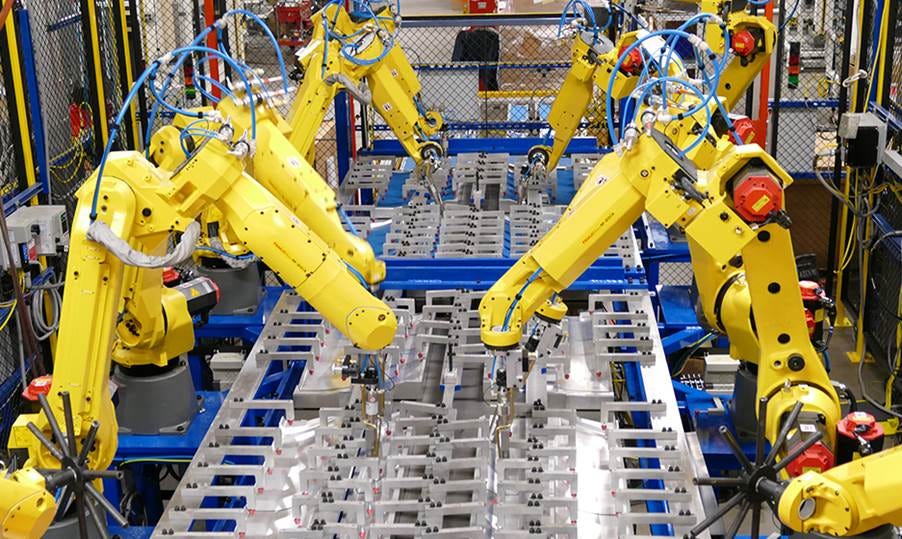
Source: TA Systems Assembly Lines
Assembling and solderng PCBs and similar microelectronics is usually fully automated. And who’d want to do that anyway?
That’s just the point, so far “robots” have been used to replace tedious “accord” type assembly lines that would just give you and me carpal tunnel besides a potential mental condition after doing them for a few months.
But “Robotics” now gets a new meaning: conquering more and more manual labor areas that necessitate a “humanoid”, or bipod. As AP Research demonstrates, my guess is also the first fully automated field will be in logistics (warehousing) and after that, last mile delivery is up for automation.
Amazon warehouses might well be largely automated - with only some human supervision maybe even in the very near future even.
However: Will elder care be automated? I doubt it before 2050 if no miracle of efficiency and upgrading is unleashed – which I believe to be the current fever dream for AI in general. I did not want to get carried to my bathtub by a Terminator-looking robot - unless he has a smiley face painted on it and coos me to sleep every night with a goodnight song - if I can still choose at that time.
But at the point where fully autonomous, potentially self-improving humanoid robots enter the picture we’d have to ask the question: why would AI do this “for us” in case it would become “self-aware”? I know this is the holy grail in neural research, but given the insurmountable tasks for humans, a baseline of “self-awareness” would be necessary in my opinion to really move the needle in “robotics”.
Here Comes the Age of Energy and Demographics Stagflation
While all these resource-hungry and land-grabby things are happening based on the “forever bullishness” backed by massive governmental and industrial capital allocations to “build AI as the next industrial revolution”, the world is in an underreported poly-crisis.
We have at least one major geopolitical hot conflict in the Strait of Hormuz, a sweltering one around Taiwan’s independency. We have energy cut off from parts of the world thanks to the Strait of Hormuz being closed for almost three months. We have massive bouts of inflation coming from monetary policy that has ripped the fabric of what’s possible to sustain ever since the casino almost broke in 2008’s “financial crisis” - which really just was a giant credit misallocation paired with massively lax underwriting standards because “what could go wrong” thinking prevailed. And if that doesn’t feel at least partially “same” to what’s happening now, we have to also consider trade wars, tariffs, unhinged political posturing reducing “policy safety” across the board, at which businesses feel safe investing capital and growing their lot.
The dwindling and blockaded resources via contested shipping lanes and trade routes give me the impression, we’re quickly approaching the end of AI financing runway where the goldilocks environment thinking changes to “danger territory”.
By overloading debt-to-GDP ratios across the board due to waning demographics with new and massive debts that are supposed to “save us” we might just be entering monetary “endgame” for fiat major currencies. We’re quickly out of time to truly “save ourselves” when it comes to your personal capital. Investing in SpaceX might go fantastically well if the euphoria keeps carrying – who knows what irrational numbers people believe and pay for in stock valuation… we’ll find out soon.
But: only a few countries still have more births than deaths and the geriatric sunset is close for advanced nations like Japan, Germany, France and many others – all leaders of GDP statistics for now with a visible cliff approaching fast.
I’m afraid this piece has become way more “doomster” than I’d wished it to be – so let’s end it a positive note:
AI’s not there yet at “saving us all and the economy”, its promise gives the world an outsized chance of turning our fortunes around for the good of all society.
My belief is that if AI gets to the “truly intelligent” level that will enable it to understand the physical world and its effect on it, and thus take appropriate decisions, we might even replace some or all politicians with it. This would do away with the ego, grift and corruption running through the current political system in its final stage. Instead we’d focus on efficient and slim administrative governance that leaves the economy to its best devices - expansion and growth based on what’s needed and wanted instead of mandated.
Now there’s a happy ending thought!

One side ties out while the other side requires you to believe known, well established liars as they are lying to you. Hard choice
Thanks for including our work. You did a better summary than I could.